I developed these frameworks for my own emotional healing. Not as a therapist, but as someone who spent years entangled in the Fantasy Loop Framework before I fully grasped what I was experiencing. What I have created is what I wish someone had given me during my journey, particularly when dealing with my nervous system response.

The Fantasy Loop Framework isn't a character flaw; it isn't weak will, poor judgment, or a failure to love correctly. Instead, it represents a nervous system response — a survival pattern formed from early experiences of love that were inconsistent, conditional, or difficult to earn.
When love feels like a chase, that's familiar. Conversely, when love feels like safety, it can feel threatening. The brain often confuses intensity for intimacy because that is what it has learned.
Understanding the Fantasy Loop doesn't necessarily break it, but it is where the journey of emotional healing begins.
If you recognize yourself within this cycle, the assessment will reveal exactly which stage is most active for you right now and outline the path forward from there.
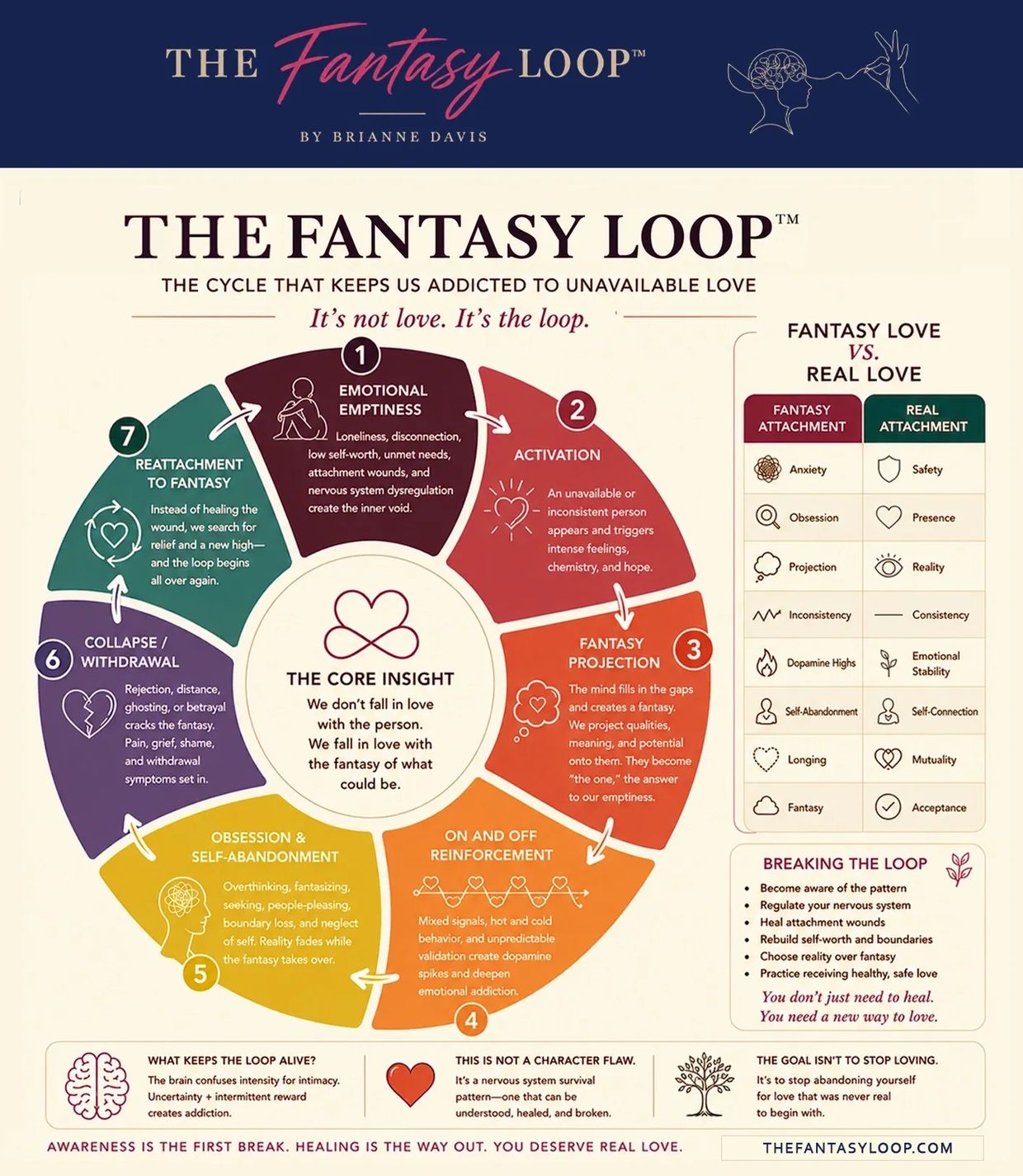
If you've heard the word limerence and recognized yourself in it, you're already close to understanding the Fantasy Loop Framework. Limerence — the involuntary, obsessive attachment to another person — isn't just a personality quirk or a sign you love too hard. It's actually a reflection of specific nervous system responses, manifesting as Stages 3, 4, and 5 of the Fantasy Loop simultaneously.
Stage 3 is where limerence truly resides: Fantasy Projection. In this stage, your mind fills the gaps, and you stop seeing the real person. Instead, you perceive the story you've constructed around them. Stage 4 feeds into this illusion, where the dopamine spike from intermittent reinforcement becomes significant — their inconsistency doesn't push you away; rather, it pulls you deeper into that emotional healing process. Stage 5 reveals the cost: obsession, boundary loss, self-abandonment, and a world that shrinks down to that one person who isn't fully choosing you.
Limerence feels like love because it activates the same reward systems within us. However, love is not a withdrawal symptom. The Fantasy Loop Framework helps to clarify the critical differences between the two.
One of the most disorienting experiences of the Fantasy Loop Framework — and one almost nobody talks about — is what happens when something safe and consistent finally arrives.
It feels wrong. Boring. Flat. Like something must be missing.
This isn't a sign that the person isn't right for you. It's a sign that your nervous system response has been trained to read anxiety as love and calm as danger. When you've spent years in the loop, intensity became the signal for connection. Consistency doesn't register the same way — because it never triggered dopamine the way uncertainty did.
This phenomenon is sometimes called peace panic: the nervous system's alarm response to stability. It's Stage 7 of the Fantasy Loop — reattachment to fantasy — disguised as intuition.
It is not intuition. It is pattern recognition trained on the wrong data.
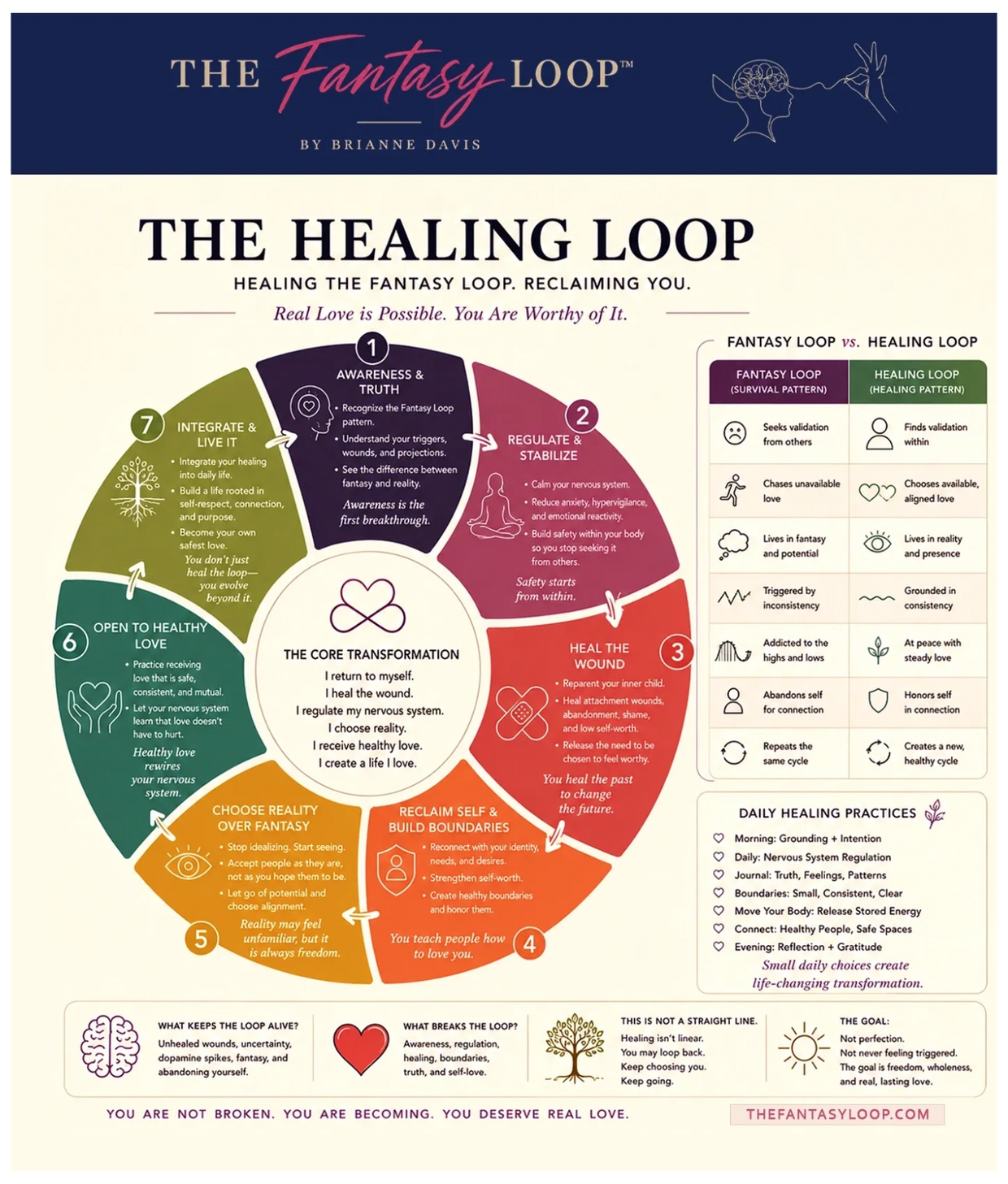
The Healing Loop doesn't just help you stop chasing unavailable people. It supports emotional healing by recalibrating what safety feels like — so that when real love arrives, you can recognize it and stay.

Healing the Fantasy Loop Framework is not a straight line; it involves looping back to previous stages. There will be days when Stage 1 feels like home again, even after you've navigated the complexities of Stage 6. This isn't a sign of failure — it's simply how emotional healing occurs. Our nervous system response operates in cycles, rather than in a neat upward trajectory.
The Healing Loop isn't a mere checklist; it's a map to guide you. It serves as a reference point when you lose your bearings, when new relationships emerge and the old patterns resurface, reminding you that your feelings are part of a pattern — not a predetermined destiny.
Real love is attainable, not because the right person will magically appear to resolve everything, but because you will heal the barriers that made unavailable love seem like the only choice.
You don't just heal the loop; you evolve beyond it.

Understanding the Fantasy Loop Framework changes how you perceive the pattern. The Healing Loop provides you with the necessary map. But what should you do in the moment — when the obsessive thought surfaces, when you feel the urge to text, when the old pull is right there? That's exactly what The Truth Reset™ is designed for.
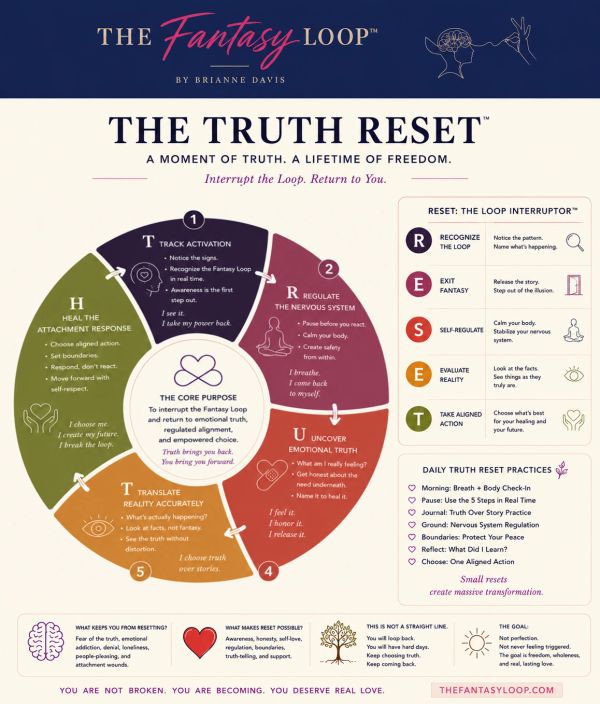
The Truth Reset is a five-step real-time process aimed at interrupting Fantasy Loop activation before it leads to behavior. It doesn't require a therapy session or a journal; it consists of five steps you can navigate in under five minutes, no matter where you are.
T — Track Activation
Notice what’s happening. Name it without judgment. I’m in the loop right now. I see it.
R — Regulate the Nervous System
Before you act, breathe. Ground yourself. Create space between the impulse and the response. I breathe. I come back to myself.
U — Uncover Emotional Truth
What’s really underneath the activation? Not the obsession — but what’s actually there? Loneliness. Fear. Grief. Shame. Name the real feeling. I feel it. I honor it. I release it.
T — Translate Reality Accurately
Examine what’s truly happening, not what your mind is fabricating. Behavior over potential. History over hope. I choose truth over the story.
H — Heal the Attachment Response
Select one aligned action. A boundary. A call to someone safe. A walk. A breath. Anything that serves you, not the fantasy. I choose me.
The Truth Reset doesn’t eliminate the loop. Instead, it elongates the moment between the loop and your response, allowing you the choice to act differently. That gap — that split second of awareness — is where emotional healing truly resides.
The Fantasy Loop Framework is not a life sentence. It does not indicate that you love wrong, choose wrong, or are inherently too much or not enough.
Rather, it represents a nervous system response — developed from early experiences of love that were inconsistent, conditional, or hard to earn. Your nervous system learned to chase love because that was the way to receive it. It also became accustomed to confusing intensity with intimacy, as intensity was often the only form of connection available.
This pattern can be understood and altered. Through emotional healing, it can be interrupted and, with time and the right tools, replaced with a healthier approach.
Awareness serves as the first step towards breaking this cycle. The assessment below helps you pinpoint your current position within the cycle. That specific, clear-eyed understanding of your own pattern is where the journey of emotional healing begins.
Copyright © 2026 The Fantasy Loop - All Rights Reserved.
We use cookies to analyze website traffic and optimize your website experience. By accepting our use of cookies, your data will be aggregated with all other user data.